Why Swim Clubs Delay Analytics Adoption
TLDR
- Most clubs skip swim analytics because the product behaves like a cost center: upfront cost, ongoing friction, unclear weekly value to families.
- Even strong tech fails when it adds workflow steps for coaches without a tight rollout plan.
- Many vendors pitch payback stories; treat them as planning hypotheses until you validate adoption and workflow wins in your own program.
- The simplest ROI model needs only a few inputs. If you can't defend those inputs with a plan, treat the output as an estimate, not evidence.
- The worked example in this article is an illustrative planning model, not a benchmark study. Replace the assumptions with your own dues, margins, labor costs, and adoption data.
The real blockers (it's not "we don't like data")
If you're trying to decide whether analytics is "worth it," don't start with a 30-line spreadsheet. Start with three questions:
- What is the weekly value artifact families will actually see?
- What part of the coach workflow gets simpler (measurably)?
- Does the product form scale to a full squad (or does it scale by devices)?
In practice, clubs get stuck on four blockers:
- Cost center framing
- "We spend money and maybe it helps."
- Operational friction
- Setup is doable, but day-to-day usage falls apart.
- Adoption failure
- Coaches and families don't change behavior, so nothing compounds.
- Trust and privacy anxiety
- Especially for youth programs, filming and data handling must be operationally safe.
There's also a product-form reality that shows up when clubs want technique:
- Sensors do not scale to technique at team level.
- If you want elbow-angle-level technique, you can't do it with a single wearable. You need multiple sensors across the body and calibration. That's inconvenient, expensive, and not scalable to an entire club session.
If your tool doesn't remove at least one blocker, it won't scale inside a club.
The business model issue: cost center vs investment
Most tools are sold like a "nice-to-have." That creates a predictable outcome: the club cuts it when budgets tighten.
An investment looks different:
- A clear weekly value artifact for parents (progress visibility, clips, goals)
- A measurable coach workflow win (less manual timing/data entry)
- A repeatable operating procedure that doesn't depend on one tech-savvy person
- Even better if clubs can make money directly with this purchase.
That's the standard swim analytics needs to meet to become normal.
The simple ROI model (the only one worth starting with)
Here's the minimal model we use to sanity-check whether payback could work. It is a planning tool, not an industry benchmark.
Inputs (7 variables)
| Variable | What it means |
|---|---|
cost_upfront |
one-time cost (hardware + install) |
cost_monthly |
monthly cost paid by the club |
N_swimmers |
swimmers affected |
retention_uplift |
churn reduction (pp/year) |
margin_month |
gross margin per swimmer per month |
coach_value_month |
value of time saved per month |
subscription_share_month |
club share of subscription revenue |
Value per month
value_month = (N_swimmers * retention_uplift/12 * margin_month) + coach_value_month + subscription_share_month - cost_monthly
Payback months
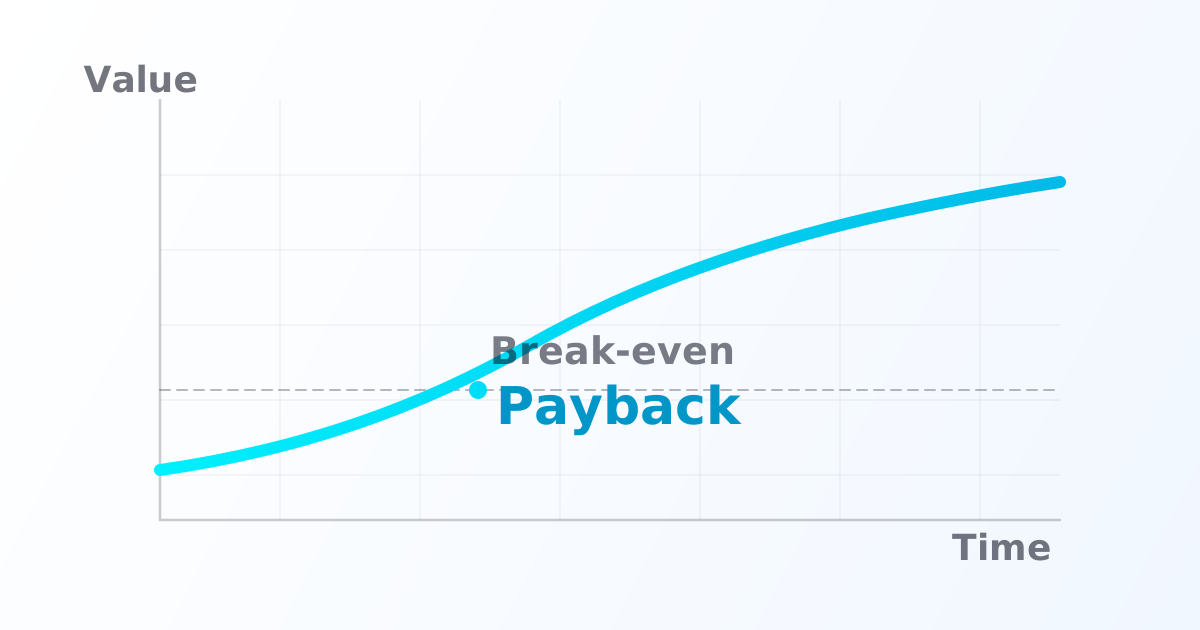
payback_months = cost_upfront / value_month
If you don't want parents to pay a subscription, set subscription_share_month = 0. The model still works if retention and workflow wins are real.
A worked example: 60-swimmer club, 3 lanes
Let's put real numbers into the model and see what comes out. These numbers are illustrative assumptions for a mid-size club, not a claim about typical market pricing or guaranteed retention lift.
Assumptions:
| Variable | Value | Rationale |
|---|---|---|
cost_upfront |
$8,000 | Hardware kit + install for 3-lane pool |
cost_monthly |
$200 | Monthly platform fee |
N_swimmers |
60 | Mid-size competitive squad |
retention_uplift |
5 pp/year | Conservative: 5% fewer swimmers leave per year |
margin_month |
$45 | Monthly dues minus direct costs per swimmer |
coach_value_month |
$300 | ~3 hours/week of manual timing eliminated × $25/hr |
subscription_share_month |
$0 | Club doesn't charge families a separate subscription |
Math:
- Retained swimmers per month:
60 × 0.05 / 12 = 0.25 swimmers/month - Retention value:
0.25 × $45 = $11.25/month - Total value:
$11.25 + $300 + $0 − $200 = $111.25/month - Payback:
$8,000 / $111.25 ≈ 72 months(6 years) — not good
Now add a subscription: if 30 of 60 families pay $15/month and the club keeps 70%:
subscription_share_month = 30 × $15 × 0.70 = $315/month- New total value:
$11.25 + $300 + $315 − $200 = $426.25/month - New payback:
$8,000 / $426.25 ≈ 19 months— reasonable
What this shows: The ROI doesn't work if analytics is a cost center. It works when families see enough value to pay for access, and when coach time savings are real. These aren't assumptions you can skip — they're the ones to stress-test first.
How to pitch swim analytics to your club board (6 steps)
If you're a coach or program director making this case internally, here's a framework that works:
-
Lead with a problem the board already feels. Don't open with "AI analytics." Open with "We lost 12 families last year who said they didn't feel like their kids were progressing. Here's what visibility looks like."
-
Frame it as revenue, not cost. Show the retention math. Even modest improvements in family retention at your dues rate typically exceed the cost of the technology.
-
Address privacy upfront, not as an afterthought. Boards of youth programs will ask. Have a one-page answer ready: what's filmed, who sees it, how long it's kept, and how families opt out.
-
Propose a pilot, not a full commitment. Most boards are more comfortable approving a 60-day pilot with defined success metrics than a 3-year contract. Define what "success" looks like before the pilot starts.
-
Quantify the coach workflow win. "Our head coach spends 4 hours per week on manual lap counting and data entry. This eliminates most of it." That's a concrete operational argument.
-
Show comparables. Point to peer sports: cycling clubs use Strava and Wahoo; run clubs use Garmin and Nike Run Club; rowing clubs use Concept2 and Nielsen Kellerman. Swimming is behind. The question isn't whether this becomes normal — it's whether your club leads or follows.
What to validate in the first 30 days (so ROI isn't a debate)
Track these leading indicators weekly:
| Metric | What to measure | Target |
|---|---|---|
| Adoption rate by group | % of coaches + families actively using | >60% by week 4 |
| Coach time saved | Minutes per practice on manual tasks | Measurable reduction by week 2 |
| Parent engagement | Weekly views of recaps/clips/reports | >40% of families weekly |
| Operational friction | Times the workflow broke or was skipped | <2 incidents per week |
| Retention intent proxy | Simple parent survey: "how likely are you to stay?" | Baseline + improvement trend |
If these are weak, payback will be weak regardless of pricing. Measuring these in the first 30 days turns the ROI debate into a data question instead of an opinion question.
FAQ
Why is swim analytics expensive for clubs?
Because the club is paying not just for "software," but for a system that must fit real practice conditions: coverage, workflow, support, and (often) hardware and installation.
Why do swim analytics tools fail in clubs?
Most failures are operational: unclear daily workflow, weak adoption, and no weekly "value artifact" for families, even if the technology works.
How much does swim analytics cost for a club?
Pricing varies widely by product form (wearables vs cameras vs post-session apps) and by what costs scale with (devices, lanes, seats, or usage). The practical approach is to model payback with your own adoption and retention assumptions.
Should a club choose wearables or cameras for better ROI?
It depends on your constraints. Wearables are portable but scale by devices; camera systems scale better to multi-lane coverage but require privacy and operating procedures. ROI depends on adoption and workflow wins, not the category name.
What is a good payback period for swim club technology?
Clubs commonly look for payback within 12–24 months, but the right threshold depends on margins, seasonality, and whether the purchase improves retention.
What metrics should a club track to prove ROI?
Adoption rate by group, coach time saved, parent engagement, operational friction, and retention intent proxies.
How do I present swim analytics to my club board?
Lead with a retention problem the board already recognizes, show the math on what reduced churn is worth at your dues rate, address privacy proactively, propose a 60-day pilot with defined success metrics, and quantify the coach workflow win. Boards approve things that reduce risk and improve revenue — frame the pitch in those terms.
What's a realistic retention uplift from swim analytics?
Conservative estimates are 3–5 percentage points per year in annual churn reduction (meaning 3–5% fewer families leave). This is the number most worth stress-testing in your own model, because it's both the biggest lever and the hardest to validate before launch. Use the 30-day tracking metrics above as early proxies.
This article is intentionally framed as an operator planning model rather than a research summary. Replace the illustrative assumptions with your club's own data before using the math in a board pitch.